New Study Finds Self-Tuning of Hearing Aids Improves Speech Quality in Real-World Sound Scenes
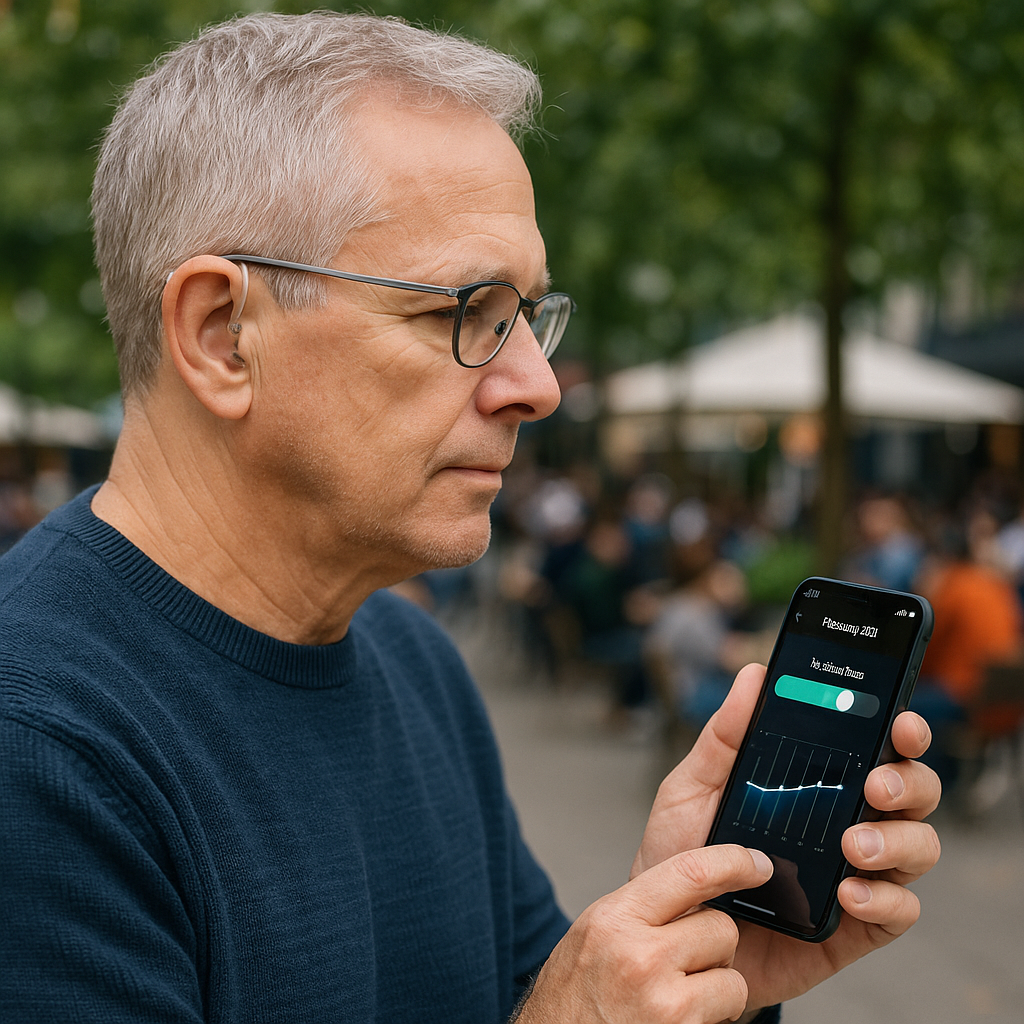
A new study published in the American Journal of Audiology has shown that allowing hearing aid users to fine-tune their own device settings for specific listening situations can significantly enhance perceived speech quality.
The research, led by Bertan Kurşun and colleagues at Indiana University, investigated whether older adults could adjust their hearing aids to match their individual preferences across different noisy environments—a concept known as scene-specific self-tuning.
Study design
Thirty older adults with hearing loss participated in a series of listening tasks simulating two common everyday environments:
- Noisy Indoor Scene – background conversation and reverberant noise (signal-to-noise ratio +5 dB)
- Noisy Outdoor Scene – open-space background sounds (signal-to-noise ratio +10 dB)
Participants used a computer interface to self-tune their hearing aid settings, adjusting frequency–gain characteristics while listening to continuous speech. Each participant evaluated four hearing aid programs in each scene:
- Two self-tuned programs (one for each scene)
- One prescription-based program (standard fitting)
- One poor-quality anchor program
Participants rated speech quality using a modified Multiple Stimuli with Hidden Reference and Anchor (MUSHRA) method, with randomized and blinded presentation order.
Key findings
Participants consistently rated their scene-specific self-tuned programs as having higher speech quality than both the standard prescription settings and self-tuned programs designed for other scenes.
These results demonstrate that users can effectively optimize their hearing aids for specific acoustic contexts, leading to measurable improvements in subjective listening satisfaction.
The findings suggest that self-directed fine-tuning—guided by intuitive digital interfaces—could become an important complement to clinician-driven fitting, particularly for patients whose hearing needs vary across different daily environments.
Why this matters
This research highlights a shift toward personalised, user-driven hearing care, where patients can actively shape their listening experience. Hearing aids have traditionally been programmed in the clinic using generalised prescriptions, but real-world environments are far more dynamic.
At Hashir International Institute and The Hearing Well Practice, clinicians increasingly integrate evidence-based verification with patient-led adjustments, reflecting the emerging model of collaborative audiology. This study supports empowering patients to engage with their technology—bridging clinical precision with personal preference.
By allowing users to fine-tune their devices in context, audiologists can help achieve better alignment between measured performance and perceived sound quality, ultimately improving communication confidence in everyday settings.
Full citation
Kurşun, B., Chessik, B., Cunio, I. E., & Shen, Y. (2025). Scene-Specific Self-Tuning of Hearing Aids Enhances Perceived Speech Quality. American Journal of Audiology, 1–14. https://doi.org/10.1044/2025_AJA-25-00077